

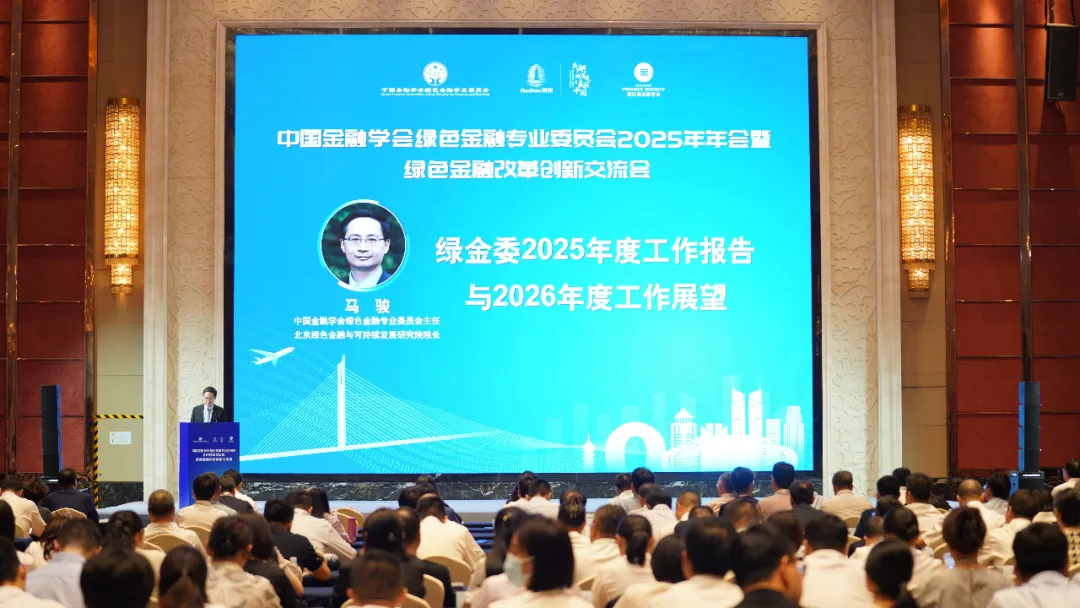
Huzhou, Zhejiang [July 4, 2025] – The 2025 Annual Meeting of the Green Finance Committee (GFC) and Green Finance Reform Innovation Forum was held in Huzhou, Zhejiang Province, commemorating the committee’s 10th anniversary. The event was chaired by Dr. Ma Jun, Chairman of the Green Finance Committee (GFC) of the China Society for Finance and Banking.
Zhang Yanyun, Vice Governor of Zhejiang Province, highlighted the province’s steadfast commitment to ecological priority and green development. Since the State Council established green finance pilot zones in Huzhou and Quzhou in 2017, these regions have become national exemplars in supporting low-carbon economic transformation. Huzhou, in particular, has seen impressive growth, with green loans expanding at an average annual rate of 40% since 2017, and the green loan ratio reaching 34% by early 2025—far exceeding the 3% average in many other developing economies.
The meeting brought together representatives from over 100 organizations, including the People’s Bank of China (PBOC), major financial institutions, and research bodies. Distinguished speakers such as PBOC Deputy Governor Lu Lei, PBOC Research Head Wang Xin, Huzhou Mayor Lian Kunming, and senior financial experts shared insights across the keynote and eight thematic sessions. The GFC and its members unveiled 18 innovative green finance reports, products, and tools, showcasing breakthroughs in policy, technology, and practice.
In his keynote address, Dr. Ma Jun emphasized the critical role of transition finance - a mechanism supporting the low-carbon transformation of industries that form the backbone of the economy. Huzhou is at the forefront of building a comprehensive transition finance ecosystem, which includes a transition taxonomy to define eligible activities; a transition projects database to connect funding with initiatives; interest subsidies for transition loans to lower financing costs; a transition plan template to guide corporate decarbonization roadmaps; and a government-led carbon registry offering free carbon accounting services to enterprises.
Dr. Ma also underscored the importance of banks developing comprehensive transition plans with clear short-, medium-, and long-term decarbonization targets. These plans should address both operational emissions (such as office energy use) and financed emissions (such as loans to carbon-intensive sectors). Effective implementation involves providing green and transition financing to support clients’ low-carbon shifts, reducing exposure to carbon-intensive assets that cannot be transitioned, and increasing support for renewable energy, energy efficiency, and circular economy projects.
Established in 2015 by the People’s Bank of China, the GFC has been a pioneer in China’s green finance landscape. Over the past decade, it has driven policy discussion, product innovation and international cooperation through numerous working groups led by financial institutions, NGOs, and service providers. Current focus areas include transition finance, sustainability disclosure, product innovation, biodiversity, inclusive green finance, and women’s sustainable development.
Huzhou’s experience demonstrates how the intersection of policy, finance, and local innovation can accelerate global climate goals. The GFC’s 10th anniversary not only marks a significant milestone but also reaffirms its commitment to scaling green and transition finance solutions that will power a sustainable future.
For more information, please find the offical press release ( Chinese only): https://mp.weixin.qq.com/s/fLpUB_CocsnIQPk86hCv2A

"Make rain" for the earth, nourishing all living things


