

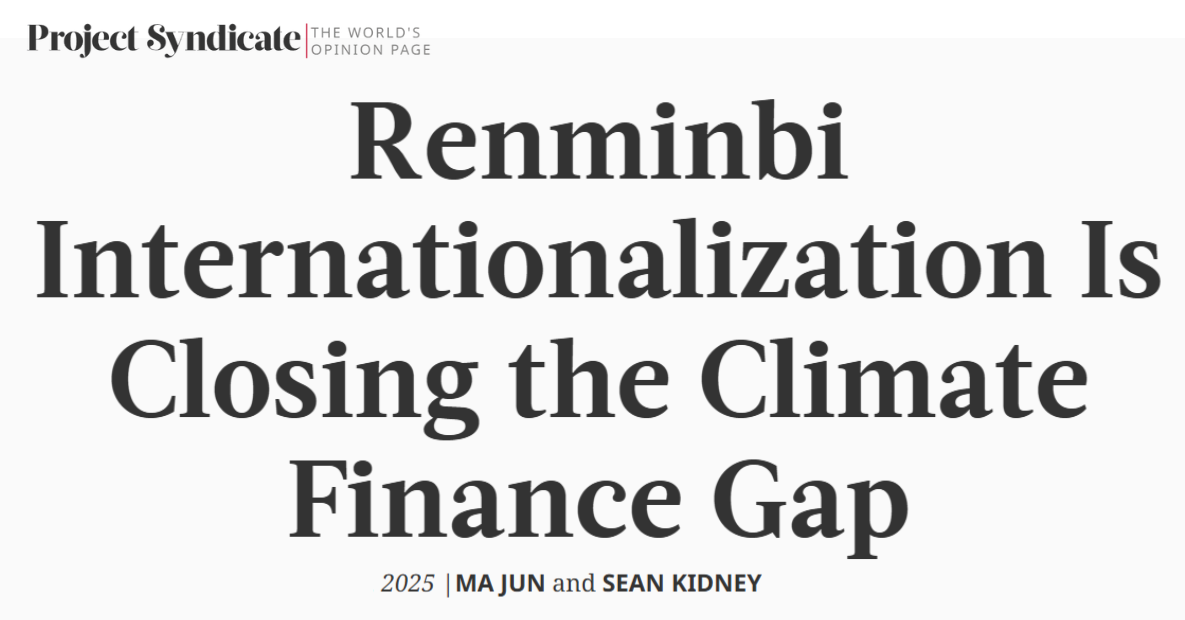
As traditional climate finance channels recede and the "higher-for-longer" dollar environment persists, a vital new pathway is opening for the Global South.
In a compelling new commentary for Project Syndicate, title “Renminbi Internationalization Is Closing the Climate Finance Gap”, Dr Ma Jun, Chairman of CASI and Sean Kidney CEO of Climate Bonds Initiative, detail how China emerging as an alternative engine for green financing for the global south.
This article delves into how China’s RMB-denominated bond markets—specifically the "trifecta" of onshore Panda Bonds, offshore Dim Sum Bonds, and Free Trade Zone (FTZ) offshore bonds—can provide low-cost avenues for funding green initiatives across the developing world.
Key takeaways:
- Cost Efficiency: Thanks to RMB interest rates that are notably lower than USD rates, issuers from developing countries have recently tapped into these Chinese markets to secure green capital at yields below 3.5%.
l Egypt issued a sustainable Panda bond at 3.51% (backed by MDBs), compared to >11% for comparable Sukuk issuance.
l Suzano (Brazil) secured green financing at 2.8% for projects protecting native forests and sequester carbon.
l These markets are delivering substantially lower funding costs than USD instruments, making renewable energy and climate resilience projects viable again.
- Strategic Access: These bond markets serve as a direct bridge, linking issuers to the world’s largest green supply chain alongside cost-competitive green technologies.
- Risk Mitigation Guarantees: We explore approaches for multilateral development banks such as the Asian Infrastructure Investment Bank (AIIB) to offer risk-mitigation mechanisms tailored for Global South issuers of green bonds in these Chinese markets.
These markets hold great potential to channel more sustainable financing to the Global South. This potential can be unleashed through stepped-up efforts to boost market awareness, enhance liquidity, and expand the range of risk-mitigation tools. Tools like the Multi-jurisdiction Common Ground Taxonomy (MCGT) can also help curb greenwashing and attract global investors to these platforms.
Read the full analysis here: https://www.project-syndicate.org/commentary/china-panda-dim-sum-ftz-bonds-closing-gap-left-by-dollar-by-ma-jun-and-sean-kidney-2025-12
The Op-ed also feature by:
Canxin (Chinese): 人民币国际化助力南方国家缩小气候融资缺口_观点频道_财新网

為地球「喚得雨露」,滋養萬物


