

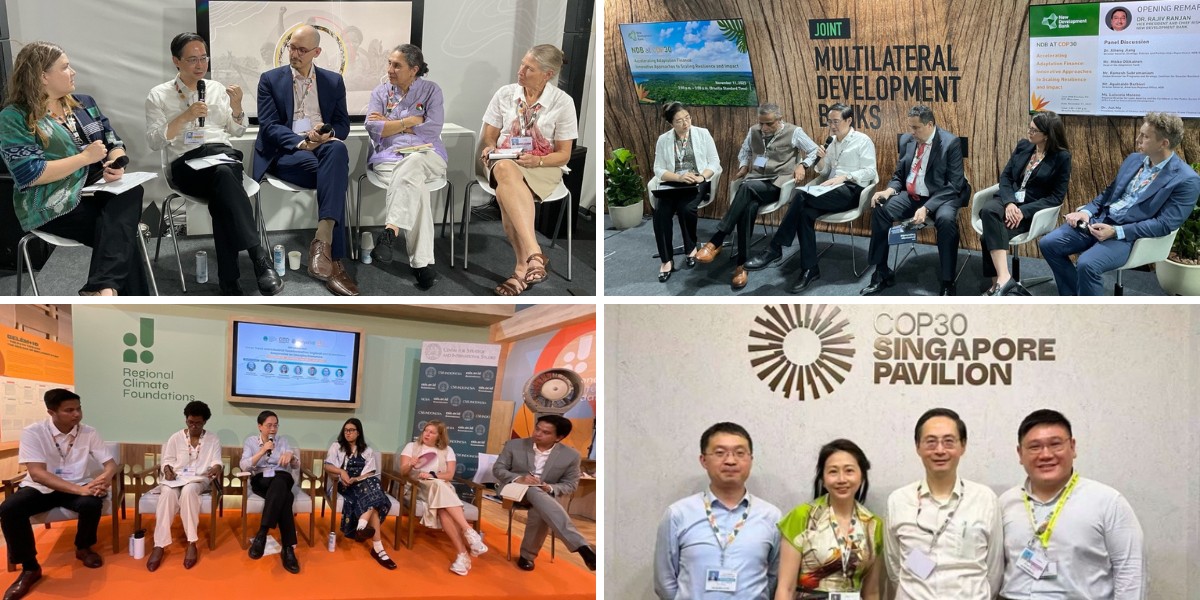
As global attention turns to COP30 in Belém, Brazil, Dr. Ma Jun, Chairman of the Capacity-building Alliance of Sustainable Investment (CASI), shares insights from his participation in high-level discussions. His engagements at COP30 reflect China’s evolving role in advancing climate finance, nature-based solutions, and international collaboration.
Dr. Ma arrived in Belém on November 10 to participate in COP30, and it has been a privilege for him to contribute to impactful discussions across the Blue Zone over November 11–12. He spoke at events hosted by the Brazilian government, New Development Bank (NDB), CSIS, Regional Climate Foundation, Ford Foundation, Center for Global Commons, and Capital Coalition, focusing on critical topics including nature financing, adaptation financing, natural capital, green taxonomies, and green trade.
Nature Financing: Sharing China’s Practical Experience
At a session dedicated to nature financing, Dr. Ma outlined China’s actionable approaches: developing and applying a biodiversity finance taxonomy, piloting the Taskforce on Nature-related Financial Disclosures (TNFD), leveraging innovative green financial tools, and rolling out incentives like preferential lending for forestry projects. Addressing why some governments prioritize incentives for sustainability, he emphasized two key drivers: longer-term policy planning that recognizes the value of sustainable investments, and strategic repurposing of existing incentives to align with green goals.
Adaptation Financing: Unlocking Private Sector Participation
During an adaptation-focused event, Dr. Ma highlighted a core barrier to private financing: the lack of bankability in most adaptation projects. Current designs often generate little to no revenue, failing to meet private investors’ return expectations. The solution lies in innovative project design—integrating resilience features (e.g., flood control, typhoon protection) into commercially viable projects like water supply and treatment, transportation, and construction. He also emphasized the value of early-warning systems as a low-cost resilience tool, noting their success in helping insurance companies minimize losses from typhoons, floods, and heavy rains.
Natural Capital Accounting: China’s GEP Framework
At a session on natural capital accounting, Dr. Ma introduced China’s Gross Ecological Product (GEP) concept and its pilot applications to finance nature conservation. He outlined three key pathways for funding ecological restoration:
- Cross-regional eco-compensation mechanisms, where beneficiaries of ecosystem services contribute financially.
- Fiscal revenue from eco-aligned economic activities, such as ecotourism, sustainable tea and Chinese herb cultivation, mineral water production, and pharmaceutical raw material sourcing.
- Carbon markets and bio-credit markets as market-based financing tools.
Taxonomy Interoperability & Green Trade
For a discussion on taxonomy interoperability, Dr. Ma updated the audience on the Common Ground Taxonomy (CGT) and the outlook for the Multi-Jurisdiction Common Ground Taxonomy (MCGT). He expressed hope that MCGT key participants will use the framework as a foundation to drive regional taxonomy harmonization in their respective continents.
At an event focused on green trade and industrial decarbonization, he emphasized that Asia must proactively respond to global headwinds for free trade and climate action. A “green trade arrangement”—reducing tariff and non-tariff barriers on green and low-carbon goods and services—offers a way forward. His research shows that such an arrangement for RCEP could boost economic growth and accelerate decarbonization across all member countries. Unlike CBAM (a “stick” for carbon-intensive exporters), green trade acts as a “carrot” to reward nations making strides in reducing carbon intensity.
China-Singapore Collaboration: Meeting Abigail Ng of MAS
Dr. Ma also had the pleasure of connecting with Abigail Ng, the newly appointed Chief Sustainability Officer of the Monetary Authority of Singapore (MAS). Succeeding Gillian Tan, Abigail will serve as Singapore’s co-chair for the China-Singapore Green Finance Taskforce (GFTF)—a role Dr. Ma has co-chaired on China’s behalf for many years. They discussed the next phase of the MCGT project and priorities for the GFTF’s 2025 workplan, and agreed to host the next GFTF annual meeting in China next year.
COP30 continues to be a platform for meaningful dialogue and action - Dr. Ma is grateful for the opportunity to exchange insights, build partnerships, and drive progress on global climate goals.

為地球「喚得雨露」,滋養萬物


